On this page 9 sections
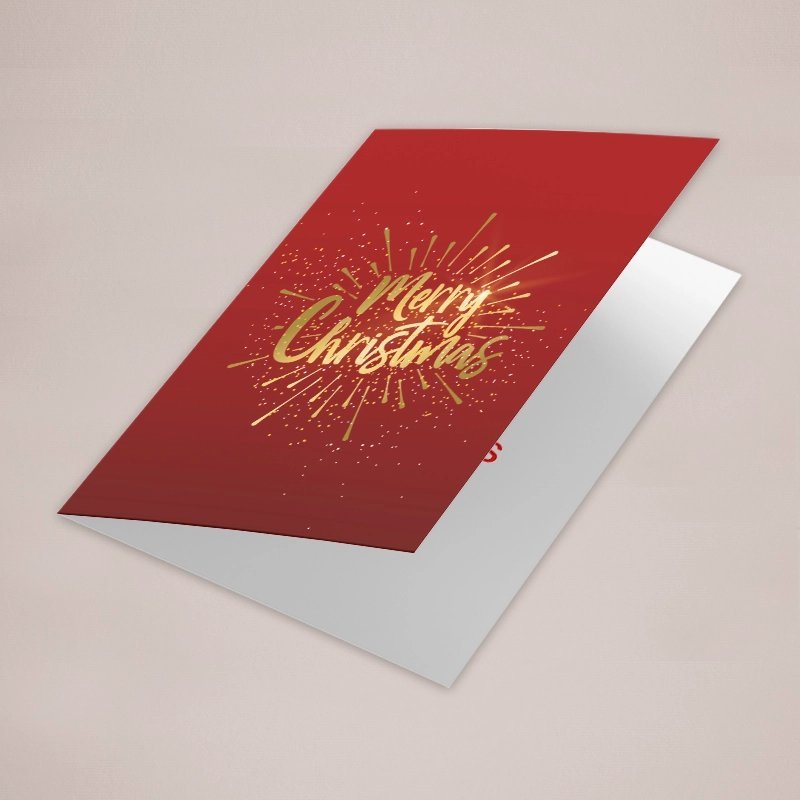
The best foil Christmas card designs use foil sparingly: a star, a single word, a snowflake pattern or a logo, set against a dark or soft-coloured card. Gold reads as warm and traditional, silver as crisp and wintry, copper as modern. Supply foil as a separate solid layer and order early, as foil adds production time.
Where foil works on a Christmas card
Foil is a thin metallic film pressed onto the card. Unlike metallic ink, it reflects light like real metal, so it glints when the card is moved or caught by fairy lights. That is the effect to design for.
Strong uses
- A single word: “Noel”, “Joy”, “Peace”, or the company name.
- A star or a bauble as the focal point of the cover.
- Fine patterns: snowflakes, stars or a simple border.
- The sender’s logo, small, on the back or the front.
Weaker uses
- Large solid areas, which can show small marks and look flat.
- Very thin hairlines and tiny text, which may not hold their detail.
- Foil over a photograph, where the shine competes with the picture.
For broader design and planning advice, see our business Christmas cards guide.
Gold, silver or copper
Our foil greeting cards come with gold, silver or copper foil on one side of an A5 portrait card with soft touch lamination.
| Foil | Feel | Pairs well with |
|---|---|---|
| Gold | Warm, traditional, festive | Deep red, forest green, navy, black |
| Silver | Cool, wintry, crisp | Midnight blue, charcoal, white, ice blue |
| Copper | Modern, warm, slightly rustic | Cream, sage, slate, terracotta |
Match the foil to your brand. A firm with a gold logo looks consistent with gold foil; a firm with a cool blue palette usually suits silver.
Setting up the foil layer
Foil needs its own artwork, separate from the full colour print. The printer uses it to make the foil plate, so it must be exact.
- Create the foil areas as solid 100 K black vector shapes on a separate layer or page. Only the shapes, nothing else.
- Name the file or page clearly, such as “foil”, so it cannot be confused with the colour artwork.
- Keep fine lines at least 0.3 mm thick and text no smaller than about 8 pt.
- Align the foil layer exactly with the colour artwork. Any underlying colour should also be planned, as foil sits on top of it.
- Keep foil away from the fold, where it can crack.
Your upload is checked automatically for resolution, size and bleed when you order. Should anything fail, the options are a corrected upload, sending the file later, a paid file check in which a person sorts it, or our design service.
Stock choices
Foil greeting cards are printed on 350gsm uncoated or 350gsm silk, with soft touch lamination on one side. The soft touch surface makes the foil stand out more, because the velvety matt contrasts with the metallic shine. Each card comes with a C5 envelope in red, white or dark green.
Dark green envelopes with gold foil cards, or white envelopes with silver foil, make a set that looks considered from the moment it lands on the doormat.
Foil and non-foil cards together
Not every card on a list needs foil. Many businesses order a smaller run of foil cards for key clients and a larger run of standard Christmas card printing for everyone else, using the same design without the foil layer. The standard cards come folded in several sizes on silk, recycled or greetings card, with an optional gloss outside.
For large mailings, printed envelopes with your return address and logo help both sets look like they came from the same place.
Ordering in time
Foil adds a stage to production. Foil greeting cards are made from 10 working days on the Saver speed, compared with 6 for standard Christmas cards, so start earlier. Our guide to when to send Christmas cards shows how to work back from posting dates; for foil, add at least a week to that plan.
Design ideas to try
- Night sky: a navy card scattered with small silver stars and one larger star in the centre.
- Forest: a deep green card with a row of simple gold fir trees along the foot.
- Typographic: a cream card with “Season’s Greetings” set in a fine serif, the first letter in copper.
- Bauble: a single large bauble outline in gold foil on burgundy, hanging from a thin line.
- Corporate: the company logo in silver foil above a short greeting, on charcoal.
Each of these keeps the foil to a small share of the cover, which is where it looks richest.
Keeping foil cards looking good
Store cards flat in their box until you write them. Use a ballpoint or gel pen inside rather than a felt tip, which can smear on uncoated board. Avoid stacking freshly written cards face to face, so ink does not transfer onto the foil.
Find foil cards alongside every other festive format in our postcards and greeting cards range.
Questions
What are good foil Christmas card designs?
Simple ones: a single word, a star, a snowflake pattern or a logo in foil on a dark or soft-coloured card.
Which foil colours are available on Christmas cards?
Foil greeting cards come in gold, silver or copper foil.
How do I set up foil artwork?
Supply the foil areas as solid black vector shapes on a separate layer or page, aligned with the colour artwork.
Does foil take longer to print?
Yes. Foil greeting cards take from 10 working days on Saver, so order earlier than standard cards.
Do foil cards come with envelopes?
Yes. Each foil greeting card comes with a C5 envelope in red, white or dark green.